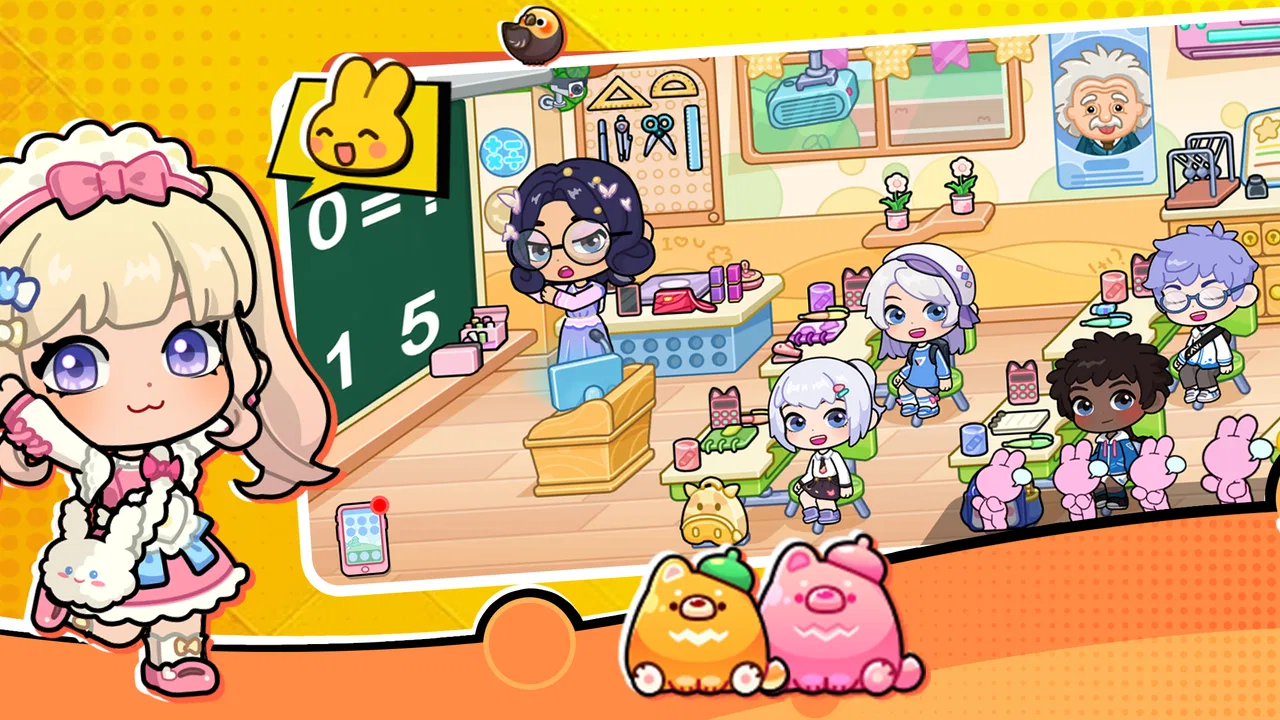
Tut world:Home Town builder
- 4.6
- Rating
- 5.00M
- Installs
- Free
- Price

 Analysis by App-foxy
I spent time with Tut world:Home Town builder, a free role-playing game built around a colorful chibi world, avatar creation, and dress-up play. Its appeal is easy to understand: instead of pushing me through a fixed adventure, it gives me a playful space where appearance and everyday character-making are the main attraction. I could treat it as a relaxing customization toy, a small creative project, or a casual game to open when I wanted something lighter than a combat-focused RPG.
The game comes from Hainan Hengdou Network Technology Co., Ltd. and is aimed at Everyone, which fits its bright cartoon presentation. It was released on October 19, 2024, and the current version is 1.0.34. It runs on Android 7.0 or later, so it is accessible on a wide range of Android devices rather than being limited to recent phones. The store shows a 4.6 average from around 14 thousand ratings, while its install count has passed 5 million, suggesting that the basic idea has reached a sizeable audience.
How the free model affects the experience
The most important cost detail is simple: the game is free to download and play. That makes it easy to try without committing money first, which is especially useful for this kind of dress-up and avatar-making experience. I could decide whether the visual style and creative loop suited me before considering any optional spending.
You May Also Like

 Blood Strike: 2.5 Anniversary
Blood Strike’s Loadouts Turn Every Drop Into a Tactical Gamble
A close look at Blood Strike’s custom loadouts: how fast access to signature weapons reshapes its battle royale rhythm, rewards preparation, and narrows the gap between fights.

 Pandora - Music & Podcasts
Pandora’s Music Is Easy to Start, but Harder to Recover
Pandora’s strength is its low-effort path from a seed to a station. Its weak spot is how much confidence it asks you to place in connection, setup, and quiet recovery.

 8 Ball Pool
 Is Built on Rivalries, Rematches, and Routine
A close look at the rivalries, rematches, shared routines, and unanswered safety questions that turn a quick pool match into a persistent mobile community.

 Samsung Music
’s Quiet Strength Is Playing What You Already Own
Its reach comes less from spectacle than from dependable access to a personal library. That simplicity is both the app’s strongest retention engine and its ceiling.

 AccuWeather: Weather Radar
AccuWeather Review: A Quick, Clear Forecast for Everyday Decisions
For everyday plans, the best forecast is the one you can understand quickly. AccuWeather makes rain timing, radar, and local conditions easy to act on, with a few trade-offs.

 Hill Climb Racing
Why Hill Climb Racing Still Turns Crashes Into One More Run
A tiny car, a bumpy hill and one more upgrade: Hill Climb Racing keeps resurfacing because its simple chaos makes every near-miss feel personal.
More From Our News Desk



There are in-app purchases ranging from $0.99 to $159.99 per item. That is a very broad range, so I would approach the purchase side carefully. The free entry point is a genuine advantage, but the presence of high-priced individual items means the game should be treated as a free-access title with optional paid content, not as a completely cost-free experience in every respect.
For me, the sensible way to use it is to begin with the free portion and establish a personal limit before browsing anything that costs money. A child using the game should have purchase controls handled by a parent or guardian. The Everyone age rating describes the intended audience, but it does not remove the need for ordinary care around spending on a shared device.
I also would not judge the value of a purchase by how much content appears on the store page. In a customization game, the value of an item is personal: a hairstyle, outfit, or visual detail can matter a lot to one player and almost nothing to another. Since the individual purchase prices vary widely, I would only pay for something I expected to use repeatedly in my own characters rather than buying several items impulsively.
What I actually get from the core loop
The strongest part of the game is the act of shaping a character’s look. The chibi presentation makes small visual changes feel noticeable, and the dress-up focus gives the experience a gentle, low-pressure rhythm. I could experiment without needing to master complicated controls or understand a long story before enjoying myself.
That makes it different from a conventional role-playing game where progression, battles, quests, and equipment usually determine whether I am having fun. Here, the creative decision is the activity. Choosing a general style, adjusting the character’s appearance, and imagining where that character belongs in the home-town setting can be more satisfying than chasing a numerical upgrade.
One useful way to approach it is to create a theme before opening the customization options. Instead of randomly trying every item, I might decide on a cheerful school-day look, a cozy home outfit, or a more dramatic fantasy-inspired character. This keeps the large number of visual choices from becoming tiring and turns the session into a small design task.
Another practical workflow is to make one character slowly, then revisit the design after a break. I often notice that a combination that seemed exciting at first is too busy once I look at it again. A second pass helps me compare the overall silhouette, colors, and accessories rather than getting distracted by each individual item. That is a more useful habit here than simply collecting every option I can find.
The home-town framing also gives the characters a sense of context. Even when my main interest is avatar creation, a character feels more complete when I imagine how they fit into the surrounding world. I can use that idea for casual storytelling, make a small cast with contrasting personalities, or simply create a character that matches my mood for the day.
Where it fits beside other role-playing games
Compared with action RPGs, this game is much less about reflexes and combat decisions. Someone looking for difficult battles, deep equipment builds, or a demanding campaign will probably find the experience too gentle. Its role-playing identity comes more from self-expression and imagining a character’s life than from tactical systems.
Compared with a pure avatar editor, however, the town setting gives the customization a little more atmosphere. I am not only selecting a face or outfit in isolation; I am placing that character inside a cartoon world. That distinction matters if I enjoy making characters but want more context than a static creation screen provides.
It also differs from a traditional dress-up title that is organized mainly around completing a specific look or passing a fashion challenge. The appeal here is more open-ended. I can spend a short session changing one detail, or stay longer while developing a personal cast. The trade-off is that players who need clear goals may feel less directed.
Small workflows that make the game more enjoyable
My first tip is to separate experimentation from final design. During the first pass, I would try unusual combinations without worrying about whether they match. During the second pass, I would remove anything that competes with the character’s main idea. This prevents the common dress-up problem where adding more items makes the result less distinctive.
My second tip is to use the game as a visual planning tool for simple creative projects. A character made here can help me think through a color palette, personality, or outfit concept before I draw it elsewhere. It is not a replacement for a full illustration program, but the quick feedback from a chibi avatar can help when I am stuck on the broad direction of a character.
My third tip is to treat paid items as finishing touches rather than the foundation of the experience. I would first see whether I can create a character I genuinely like using the free access. If I cannot enjoy the design process without purchasing something, spending more is unlikely to solve the underlying problem. If I already enjoy the game, then a carefully chosen item may feel more worthwhile.
A fourth useful approach is to make the game part of a short routine. For example, after school or during a quiet break, I could spend ten minutes adjusting one character instead of trying to complete a large objective. That suits the relaxed nature of the experience and avoids turning a casual creative game into another task that demands a long session.
Limitations I noticed in the overall proposition
The open-ended design can also be its weakest point. Without a strong personal goal, I may finish the initial makeover and wonder what to do next. Players who prefer constant rewards, structured missions, or a clear story arc should be realistic about this: the game’s value depends heavily on whether they enjoy creating and imagining rather than simply progressing.
The visual focus may also feel repetitive if I am not interested in fashion or character design. Changing outfits is enjoyable when I am invested in the result, but it is not automatically engaging for everyone. A player who wants a deeper role-playing system may prefer a game with more substantial narrative or mechanical progression.
There is also a practical attention cost. A large wardrobe or many customization choices can be fun at first but tiring when I am trying to find one particular combination. My solution is to start with a clear concept and stop once the character communicates that idea. Continuing to add details just because they are available usually makes the process slower without making the result better.
The purchase structure deserves the most caution. Free access lowers the barrier to entry, but the range from $0.99 to $159.99 per item means the paid side is not equally approachable at every level. I would not describe the game as good value for every possible purchase. I would describe it as worth trying for free, with paid value depending entirely on the specific item, my usage, and my spending boundaries.
Who is likely to get the most from it?
I think it is a good match for players who enjoy chibi avatar creation, casual dress-up, and light role-playing without pressure. It can work well for someone who wants to invent characters, test outfit ideas, or enjoy a colorful world in short sessions. The Everyone rating and modest Android requirement also make it a reasonable option for families to consider, provided purchases are managed responsibly.
It is particularly suitable for a player who likes making several different personalities rather than perfecting one powerful hero. One character might be bright and playful, another quiet and cozy, and another deliberately extravagant. The fun comes from the contrast between them and from imagining how each belongs in the same home-town setting.
I would be less likely to recommend it to someone who wants a competitive challenge, a serious story, or a combat-heavy adventure. It is also not the best choice for a player who dislikes browsing visual options or who needs a clearly defined checklist of objectives. In those cases, a more traditional role-playing game would offer stronger direction and a more obvious sense of progress.
For parents, I would frame it as a creative dress-up game rather than a deep educational tool or a full-scale RPG. The visual style is approachable, but the free price does not mean every optional item is free. Before handing over a device, I would check the purchase settings and explain that trying the game costs nothing while selected extras can cost real money.
My buy-or-skip verdict
I would recommend downloading it if the idea of building cartoon characters sounds more appealing than fighting monsters or following a long quest line. The free access makes the decision low risk, and the game has enough personality in its chibi, home-town approach to stand apart from a plain avatar editor. Its strongest value is not measurable progression; it is the freedom to create a character and enjoy the process.
I would skip it if I need a role-playing game with demanding mechanics, a substantial narrative, or a reliable stream of goals. I would also avoid treating the purchase catalog as a reason to start spending immediately. The game is most convincing when I enjoy the free creative loop first and view optional items as selective additions.
Overall, I see it as a pleasant, accessible character-making game rather than a complete substitute for a larger RPG. The developer, Hainan Hengdou Network Technology Co., Ltd., has positioned it for a broad audience, and the strong average rating alongside more than 5 million installs shows that the concept has found plenty of interest. My honest recommendation is to try it with a personal spending limit, build a few characters around clear themes, and keep it if that relaxed creative routine genuinely holds your attention.
FAQs for Tut world:Home Town builder
01What is Tut World: Home Town Builder?
Tut World: Home Town Builder is a creative, child-friendly simulation game where players can explore a colorful town, visit different locations, and interact with characters and objects. Rather than focusing on strict missions or competition, the game encourages open-ended play, storytelling, decorating, and role-playing. It is designed for players who enjoy building scenes and inventing their own everyday adventures.
02How does the gameplay work in Tut World: Home Town Builder?
Gameplay is based mainly on exploration and interaction. You can move between areas of the town, choose characters, customize scenes, and use available objects to create your own situations. There is no complicated control system, so younger players can usually begin playing quickly. The experience feels more like a digital dollhouse or town sandbox than a traditional game with difficult levels, timers, or combat.
03Is Tut World: Home Town Builder suitable for children?
The game is aimed primarily at children and casual players, with bright visuals, simple interactions, and a relaxed style. It does not appear to rely on intense action or frightening content, making it appropriate for imaginative family-friendly play. However, parents should still review the app’s age rating, privacy information, advertising, and purchase settings before allowing children to play, especially on a shared mobile device.
04Does Tut World: Home Town Builder require an internet connection?
Some parts of the game may work without a constant internet connection, which is useful for playing while traveling or when Wi-Fi is unavailable. Nevertheless, connectivity can be required for downloading the app’s content, displaying advertisements, restoring purchases, or receiving updates. Because offline availability may vary between versions and devices, it is best to test the game after installation rather than assuming every location and feature will work offline.
05Are there in-app purchases or advertisements in Tut World: Home Town Builder?
The availability of advertisements and optional purchases can depend on the version of the app, your region, and the device platform. Some content may be accessible for free while additional characters, locations, items, or features could require payment. Before downloading, check the official store listing for current pricing and purchase details. If children use the app, parental controls and purchase restrictions are strongly recommended.
Pros
- Creative home and town-building tools encourage imaginative play.
- Friendly characters and locations make the game approachable for children.
- Simple touch controls are easy for young players to understand.
- Open-ended activities allow children to play without strict objectives.
- Regular content updates can add new areas
- items
- and customization options.
Cons
- Many locations and items may require separate purchases or subscriptions.
- Gameplay can feel repetitive after exploring the available activities.
- Some features may need an internet connection to work properly.
- Large downloads and updates can use considerable storage space.
- Parents should review privacy and advertising settings before allowing play.

Tut world:Home Town builder
Gallery